
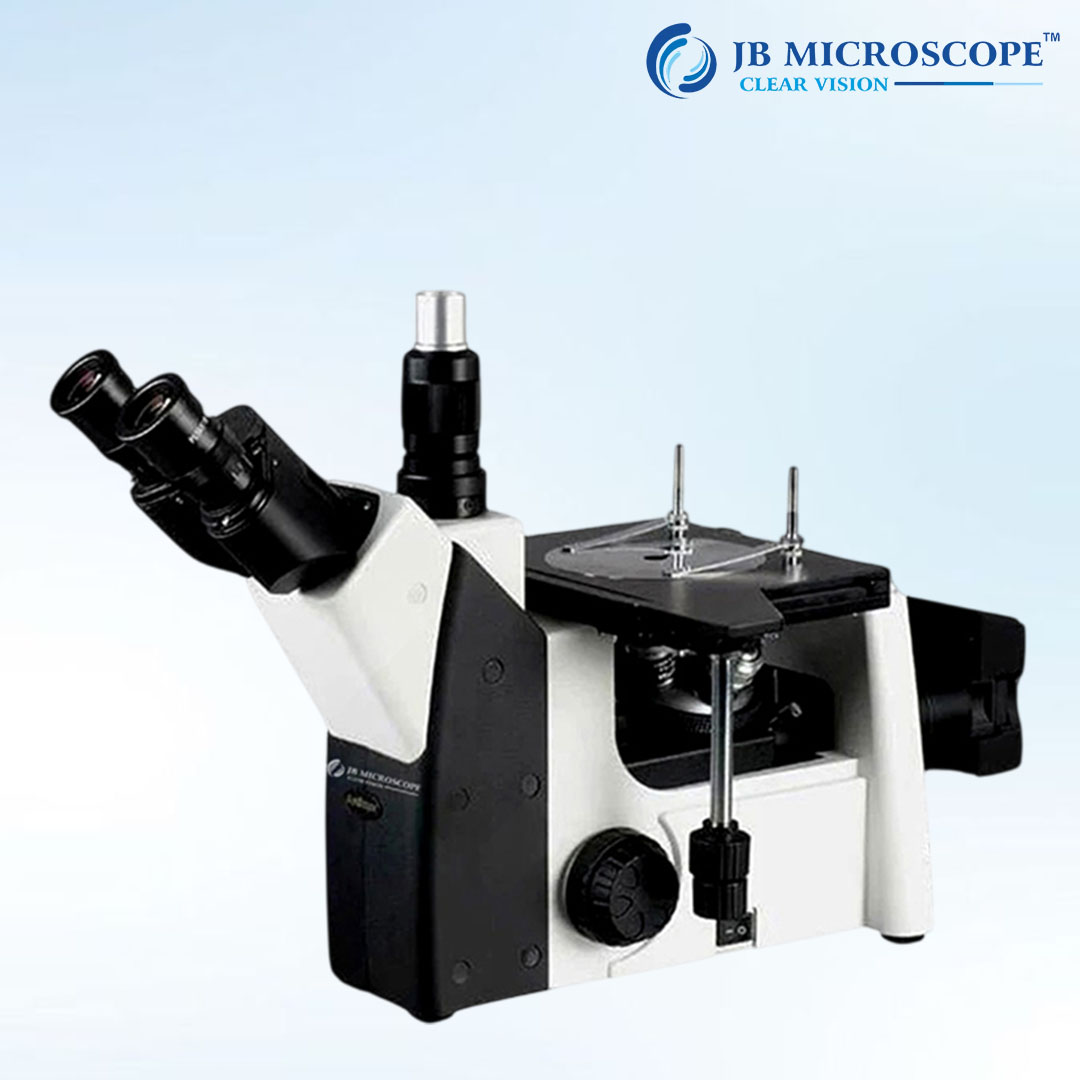
| Head | Compensation Free Trinocular Head, 45° Inclined, 360° Rotatable, Interpapillary Distance 54~75mm, Diopter Adjustable, Light Split 8:2 | |
| Eyepiece | High Eyepoint Plan PL10x/18mm, | |
| Objective | Long Working Distance Plan Metallurgical Achromatic | LMPL5X/0.15 |
| LMPL10X/0.3 | ||
| LMPL20X/0.4 | ||
| Long Working Distance Plan Metallurgical Achromatic, Semi-APO | LMPL50X/0.6 | |
| Stage | Triple Layer Working Stage, Size 180*155mm, Moving Range 75*40mm | |
| Metal Plate, Center Hole Dia.25mm | ||
| Metal Plate, Center Hole Dia.12mm | ||
| Focusing | Low Position Coaxial Coarse & Fine Focusing, Coarse Focus Range 38mm, Fine Focusing Precision 0.002mm, with Tension Adjustment, with Up-limited Stop | |
| Condenser | Swing-out Condenser N.A.0.7, for Transmit Light | |
| Filter | Blue Filter, Dia.32mm | |
| Illumination | Reflect Kohler Illumination, with View Field Diaphragm, with Iris Diaphragm, Center Adjustable, 5W LED, Warm Light, Brightness Control | |
| Power | 90-240V Wide Range Power Supply | |
An Inverted Metallurgical Microscope is a powerful tool designed for the examination and analysis of impervious materials, particularly in the field of metallurgy. Unlike traditional microscopes, the inverted design allows for the placement of the specimen beneath the objective lens, offering incomparable flexibility and ease of use.
Key features of Inverted Metallurgical Microscopes include powerful magnification capabilities, advanced illumination systems, and high-quality optics. These microscopes are specifically engineered to observe metallographic samples, allowing for detailed inspections of the microstructure, grain boundaries, and other important characteristics of metallic materials.
The inverted configuration is particularly advantageous when dealing with larger or bulkier samples that may be challenging to prepare and observe in a traditional upright microscope. This design facilitates the examination of samples in containers or vessels, such as petri dishes or metallurgical mounts.
In metallurgical applications, these microscopes play a crucial role in quality control, research and development, and failure analysis. Industries such as metallurgy, materials science, and manufacturing rely on the precision and accuracy provided by inverted metallurgical microscopes to ensure the integrity and performance of metal components.
Whether used for routine inspections or in-depth research, an Inverted Metallurgical Microscope is an indispensable tool for professionals seeking to research into the elaborate world of metallography. With cutting-edge technology and ergonomic design, these microscopes empower researchers and engineers to uncover crucial insights into the structure and composition of metallic materials, ultimately contributing to advancements in various industrial fields.


Reviews
There are no reviews yet.